
Written by: Dr. Lindsey Blodgett, PhD, LPC
Before Leadlight was a counseling practice, stained glass was a metaphor I used in the therapy room.
My fascination with stained glass started years earlier, when I was an undergraduate at Hope College. I would sit beneath the rose window in Dimnent Chapel and look up at this enormous window made from hundreds of individual pieces of glass.
I didn’t know then that the image would follow me into my work as a therapist. I didn’t know I’d become a therapist at all — let alone that a window would end up as the name and visual identity of a practice. But it did and I did and here we are, double digit years later.
As I became a therapist, I found myself asking clients to imagine something.
Imagine you’re this window, I’d say, pointing to the large window in my first office, to the right of the oversized hand-me-down leather loveseat.
Here you are minding your business, doing what you were created to do: being a whole, intact window, doing window things.
And then one day, someone throws a brick through it.
You are shattered.
Maybe the brick is something that happened to you. Maybe it’s something you lost. Maybe it came from someone you trusted. Maybe you’re the one who threw it. Maybe there wasn’t one dramatic moment at all, but enough smaller impacts over time that eventually something gave way.
Whatever the cause, the window isn’t what it was before. You weren’t what you were before.
And I think we sometimes move too quickly past that part.
Because when a window shatters, we don’t immediately look at the pieces scattered across the floor and call them beautiful.
They’re garbage.
Dangerous garbage, at that.
They’re the reason we tell the kids, Don’t come in here. There’s glass on the floor. They’re something to sweep up and dispose of carefully, something that can cut you if you handle it the wrong way.
That’s the part of the metaphor that has always mattered most to me. When something has shattered us, the pieces we’re left holding can wound.
And they don’t only harm us. When we don’t have somewhere safe to set them down, the people around us get hurt too. Not because the pieces are bad. Not because we are bad.
Sometimes we pick up a piece swearing never to forget the pain we endured, not realizing we’re opening the wound fresh every day we keep hold of it.
Healing, then, isn’t pretending the window never broke.
And therapy isn’t someone showing up with enough glue, promising to put everything back exactly where it was.
It will never be what it was before the break. There’s grief in that.
There are experiences that change us. Things we cannot undo. Losses we cannot un-lose. Parts of our stories we don’t get to rewrite simply because we’ve worked hard to heal from them.
Pretending otherwise dishonors them. But different doesn’t have to mean ruined.
None of it simply disappears. But we do get to choose what we do with it.
We can hide them. We can grip them. We can turn them over and over. Or we can entrust them.
You can gather the pieces. And if you’re willing to offer them to someone — with time, care, attention, and expertise — those pieces can be handled differently.
They can be examined. Held carefully. Set down without causing another wound. And eventually, they can become part of something new.
Not a recreation of what existed before. Not an attempt to hide every fracture or pretend the brick never came through the window.
Something different. Something more intricate. More dynamic. Maybe even something more beautiful.
There’s another part of glass that I love: no individual piece makes the whole.
Each piece has its own shape, color, opacity, texture. Some are vivid. Some barely catch your attention on their own. Some only make sense when you see what they’re beside.
And yet the whole depends on all of them. Not because they’ve been made to match, but because they’ve been joined.
That’s the part I keep coming back to. We don’t become whole by sanding every piece down until it fits smoothly against the next one. We become whole by being held — in relationship, with the people who care for us, the people who sit with us, the people whose stories intersect with ours.
A piece of glass can stay entirely itself and still become part of something new. But no single piece becomes anything on its own.
Over time, this metaphor became more than something I used with clients. It became a way of thinking about what therapy can be.
Not fixing people. Making a place where we can safely set down what we’re carrying, and where the sharp edges can be approached with care.
Where we can begin to imagine that being changed by what happened to us doesn’t mean the story ends at the breaking.
Years after sitting beneath that rose window at Hope College, that idea became Leadlight.
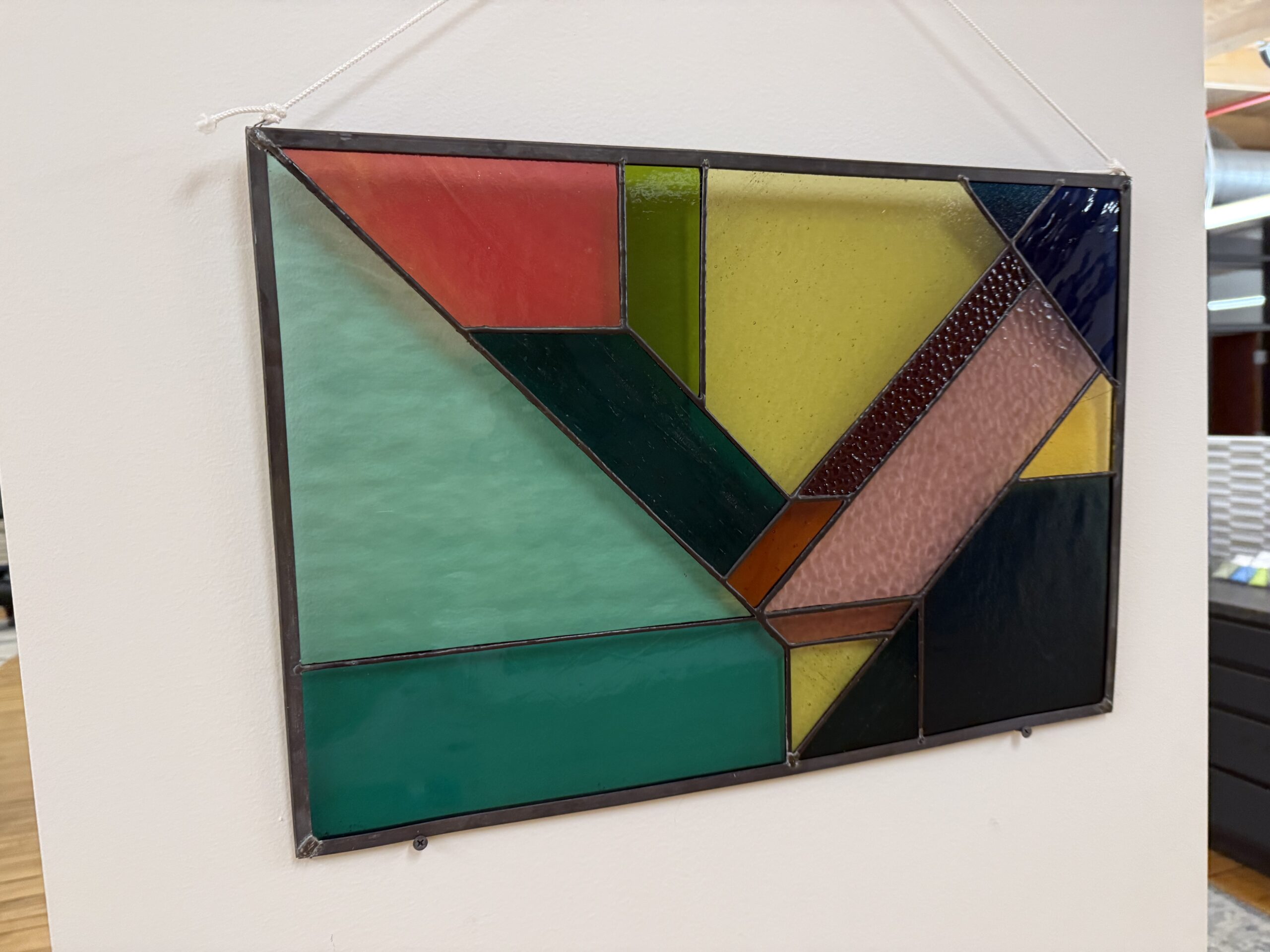
There’s a piece of glass hanging in my office. Geometric, angular, no picture in it — just color and shape. It’s the reason our brand looks the way it does.
And what you notice, if you look at it long enough, is that the black lines aren’t in the way of the design. They are the design. Take them out and there’s nothing holding the color in place.
That’s a leadlight. A window built from small pieces of glass joined by lead. The lead is the part no one photographs. It isn’t the color you notice from across the room. But it runs between every single piece, and it’s the only reason a window made of fragments can hold its own weight and stay standing in a wall.
Without it, you don’t have a window. You have glass on the floor.
It’s why glass runs through our name, our logo, our spaces, and the shapes and colors you see throughout our brand.
But for me, it has never really been about the glass.
It’s about the lead. The holding. Someone sitting with you while you take the pieces out one at a time and figure out where they might go. And the practice we’ve tried to build around that work.
But there’s a third thing here, and it was never ours.
A window doesn’t make light. It never has. It doesn’t get a say in whether the sun comes up.
All a window does is determine what happens to the light that reaches it.
That’s the part of this work I’ve made peace with slowly. I can’t manufacture meaning, or hope, or the sense that a story is worth the trouble of continuing to discover it. Nobody hands that to anyone else.
But what light passes through changes what it does in the room.
An intact window gives you daylight. Broken glass on the floor gives you a hazard and a mess. Glass that’s been gathered, and cut, and joined, and held — that gives you color on the walls.